
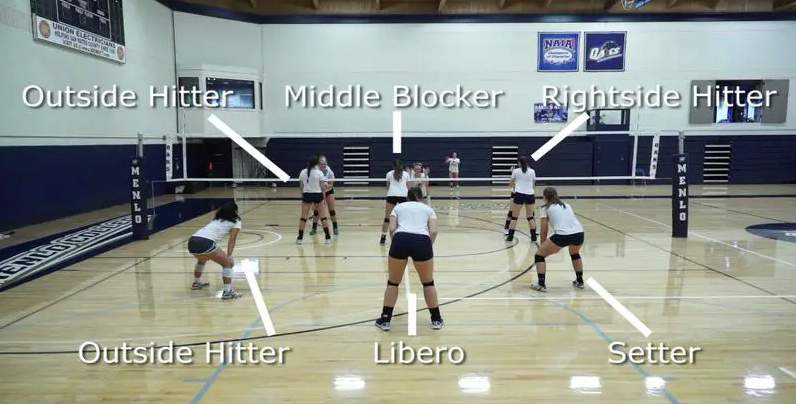
What Are The 7 Positions In Volleyball? In volleyball, there are six players on the court at once, but teams have seven specific roles to handle offense and defense. These roles include offensive attackers, defensive specialists, and the playmaker.
Table of Contents
The 7 Positions in Volleyball
- Setter (S): Often referred to as the “quarterback” of the team, the setter is the main playmaker who guides the offense. Their key responsibility is to take the second touch and provide an accurate pass (set) to an attacker.
- Outside Hitter (OH): Also known as the “left-side hitter,” this player attacks and blocks from the left side of the net. They are generally versatile athletes who manage both strong offensive hitting and back-row passing.
- Opposite Hitter (OPP): Located on the right side of the court, they are “opposite” the setter in the rotation. They act as a strong attacker and are tasked with blocking the opponent’s outside hitter.
- Middle Blocker (MB): Typically the tallest player, they play in the center of the net. Their main duty is to block attacks from opponents and execute quick, fast-tempo hits.
- Libero (L): A specialized defensive player who wears a different colored jersey. They only participate in the back row and excel in digging and serve reception. Unlike other players, they can substitute in and out without affecting the team’s official substitution count.
- Defensive Specialist (DS): Similar to the libero, this player concentrates on back-row defense and passing. However, unlike the libero, they must adhere to standard substitution rules and do not wear a different colored jersey.
- Serving Specialist (SS): A player brought into the game specifically for their serving skills. They usually enter for a teammate with a weaker serve and are substituted out once their team loses the point.
Overview of Primary Volleyball Positions and Their Core Focus
| Position | Primary Role | Court Side | Key Responsibility |
|---|---|---|---|
| Setter | Playmaker | Right | Running the offense; second touch |
| Outside Hitter | Lead Attacker | Left | Hitting and passing; versatile |
| Opposite Hitter | Power Hitter | Right | Blocking opponent OH; back-row attack |
| Middle Blocker | Blocker | Center | Reading offense; quick middle attacks |
| Libero | Defender | Back Row | Digging and serve-receive |
| Defensive Specialist | Defender | Back Row | Supporting defense and passing |
| Serving Specialist | Server | Service Line | Strategic, high-pressure serves |
How the Positions Work Together: Rotation and Strategy
The charm of volleyball is found in the interactions of these experts. The current 5-1 offense (one setter, five hitters) is the norm. In this setup, the setter directs the offense from the back row, enabling three front-row hitters (Outside, Middle, Opposite) to strike simultaneously. The libero is consistently present on the court for defensive support. Coaches use Defensive and Serving Specialists as strategic assets, similar to a chess master maneuvering pieces to take advantage of a particular vulnerability.
Evolution of Volleyball Positions
The roles we recognize now have developed over many years. The libero was officially added to international rules in 1998, changing how defense is played. Previously, players had more general roles. As the game became faster and players grew taller and stronger, this specialization became essential for improving efficiency and competitiveness in top leagues like the Pro Volleyball Federation (PVF) and Major League Volleyball (MLV).
Frequently Asked Questions: What Are The 7 Positions In Volleyball?
What is the hardest position in volleyball?
In volleyball, the Setter is often seen as the toughest position to master because of the high mental pressure and technical skill needed to manage a team’s offense. However, the level of difficulty is usually divided into mental, physical, and technical challenges, which causes discussions among experts and professional players.
Can a libero ever attack or serve?
Yes, a libero is allowed to serve and attack, but there are important limitations that depend on the level of competition. In US high school (NFHS) and college (NCAA) volleyball, a libero can serve for one position in the lineup. However, they cannot attack any ball that is completely above the height of the net.
Why do volleyball players rotate?
Volleyball players rotate to ensure that every athlete experiences different phases of the game, including serving, front-row attacking, and back-row defending. This fundamental rule prevents a team from keeping their best blockers at the net or their best servers at the line indefinitely, thereby leveling the playing field and forcing players to develop well-rounded skills.
What’s the difference between an Opposite Hitter and an Outside Hitter?
Both players are key attackers, but the Opposite usually confronts the opponent’s top hitter and is often the main target for blocking. In contrast, the Outside is more versatile, serving as an all-around scorer and taking on most of the serve-receive responsibilities.
How do I know which position is right for me?
Think about your physical traits and instincts. Are you tall and quick? Think about Middle. Do you have a strong arm and enjoy scoring? Check out Outside or Opposite. Are you a born leader with good hands? Consider setting. Do you thrive on defensive digs? Libero or DS is the right fit for you.